WEEK2
BRIEF HISTORY OF PHOTOGRAPHY
1600’s
Camera Obscura
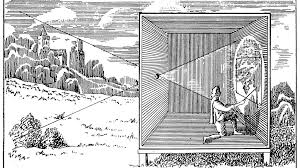
Camera obscura (plural camerae obscurae or camera obscuras, from Latin camera obscūra, “dark chamber”),[1] also referred to as pinhole image, is the natural optical phenomenon that occurs when an image of a scene at the other side of a screen (or, for instance, a wall) is projected through a small hole in that screen as a reversed and inverted image (left to right and upside down) on a surface opposite to the opening. The surroundings of the projected image have to be relatively dark for the image to be clear, so many historical camera obscura experiments were performed in dark rooms.
1800’s
Nicephore Niepce

Joseph Nicéphore Niépce (French: [nisefɔʁ njɛps]; 7 March 1765 – 5 July 1833),[1] commonly known or referred to simply as Nicéphore Niépce, was a French inventor, usually credited as the inventor of photography and a pioneer in that field.[2] Niépce developed heliography, a technique he used to create the world’s oldest surviving product of a photographic process: a print made from a photoengraved printing plate in 1825.[3] In 1826 or 1827, he used a primitive camera to produce the oldest surviving photograph of a real-world scene.
Daguerreotype

The daguerreotype (/dəˈɡɛr(i)ətaɪp, -r(i)oʊ-/;[1][2][3] French: daguerréotype) process, or daguerreotypy, was the first publicly available photographic process, widely used during the 1840s and 1850s. Invented by Louis-Jacques-Mandé Daguerre and introduced worldwide in 1839,[4][5][6] daguerreotype was almost completely superseded by 1860 with new, less expensive processes yielding more readily viewable images.
Fox Talbot – Negative Film Prints

Talbot is sometimes erroneously credited[by whom?] with introducing the principle of latent image development. The bitumen process used in private experiments by Nicéphore Niépce during the 1820s involved the chemical development of a latent image, as did the widely used daguerreotype process introduced to the public by Niépce’s partner and successor Louis Daguerre in 1839. Talbot was, however, the first to apply it to a paper-based process and to a negative-positive process, thereby pioneering the various developed-out negative-positive processes which have dominated non-electronic photography up to the present.
Camera Development

The history of the camera begins even before the introduction of photography. Cameras evolved from the camera obscura through many generations of photographic technology – daguerreotypes, calotypes, dry plates, film – to the modern day with digital cameras and camera phones.
1900’s
Birth of 35mm

Oskar Barnack, who was in charge of research and development at Leitz, decided to investigate using 35 mm cine film for still cameras while attempting to build a compact camera capable of making high-quality enlargements. He built his prototype 35 mm camera (Ur-Leica) around 1913, though further development was delayed for several years by World War I.
Kodak – Cameras

The Eastman Kodak Company (referred to simply as Kodak /ˈkoʊdæk/) is an American technology company that produces camera-related products with its historic basis on photography. The company is headquartered in Rochester, New York, and is incorporated in New Jersey.[4] Kodak provides packaging, functional printing, graphic communications and professional services for businesses around the world. Its main business segments are Print Systems, Enterprise Inkjet Systems, Micro 3D Printing and Packaging, Software and Solutions, and Consumer and Film.[5][6][7] It is best known for photographic film products.
Digital Photography

The first consumer digital cameras were marketed in the late 1990s.[1] Professionals gravitated to digital slowly, and were won over when their professional work required using digital files to fulfill the demands of employers and/or clients, for faster turn-around than conventional methods would allow.[2] Starting around 2000, digital cameras were incorporated in cell phones and in the following years, cell phone cameras became widespread, particularly due to their connectivity to social media websites and email. Since 2010, the digital point-and-shoot and DSLR formats have also seen competition from the mirrorless digital camera format, which typically provides better image quality than the point-and-shoot or cell phone formats but comes in a smaller size and shape than the typical DSLR. Many mirrorless cameras accept interchangeable lenses and have advanced features through an electronic viewfinder, which replaces the through-the-lens finder image of the SLR format.
 Dean Zou' blog